

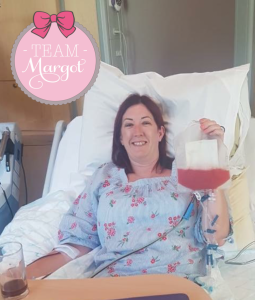
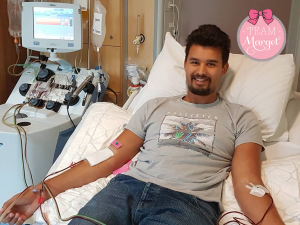
When my daughter, Margot was diagnosed with a rare and aggressive form of leukaemia in 2013, we discovered the hard way that the UK’s stem cell system was not built for everyone. Margot was mixed heritage. Finding a well-matched donor proved far harder than it should have been. That experience changed the course of our family’s life and in time, the focus of Team Margot’s work.
More than a decade later, we are at a different kind of crossroads.
An independent review of the UK’s stem cell supply system is now well underway, led by Professor John Forsythe. It was announced by the Department of Health and Social Care in March this year. For those of us who have spent years highlighting the gaps in this system, the review represents something rare: a genuine opportunity to fix what has been broken for far too long.
Team Margot has been closely involved in helping to shape the conditions that made this review possible. Through sustained engagement with the Department of Health and Social Care, the Office for Life Sciences and parliamentarians, we have argued – consistently and with evidence – that the current arrangements are neither equitable nor resilient. The decision to commission an independent review did not appear from nowhere. It is the product of years of quiet, persistent lobbying and the political space created by the All-Party Parliamentary Group on Ethnicity, Transplantation and Transfusion.
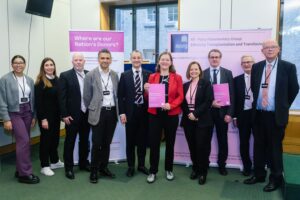
That APPG was established by Team Margot and its first inquiry report, ‘Where are our nation’s donors?’, published in December 2023, laid bare the double inequity faced by minority ethnic and mixed-heritage patients: higher need for transplants in some communities and significantly lower chances of finding a well-matched donor. The second inquiry focused specifically on the stem cell system, culminating in the recent ‘Fit for Everyone’ report, which has taken that diagnosis further. Together, these pieces of work have built a body of evidence that is now feeding directly into the independent review.
This is what sustained advocacy can look like when it is patient, evidence-based, determined and backed by persistent support. It is not glamorous. It involves meetings, submissions, follow-up correspondence and the slow work of keeping an issue on the agenda when others would prefer it to fade.
It has brought us to this moment.

The independent review is important because the problems it is examining are real and longstanding. The UK Stem Cell Strategic Forum received a clear mandate in 2010. Sixteen years later, we still lack a credible national strategy for delivering equality in stem cell donor provision. Domestic supply has declined as a share of total transplants. Reliance on expensive imports has grown. The donor panel is ageing. Absolute numbers of new minority ethnic donors have not risen in the way the system’s own targets once suggested they should. Data on unmet need remains absent, particularly for mixed-heritage patients – a group that is often invisible in the official statistics even though their genetic diversity makes matching especially difficult.
These are not new observations. They have been raised repeatedly by patients, families, clinicians and organisations including Team Margot. What has been missing is the structural accountability and the political will to act on them at scale. Lives are being lost as a result.
 We have always sought to be a critical friend to the system. We recognise the good work done by many individuals and organisations. Registries have grown. Awareness has increased. Some patients who would once have had no chance now receive transplants. But friendship that refuses to name failure is not friendship at all. The system as currently configured still fails too many people. It fails minority ethnic patients. It fails mixed heritage patients disproportionately. And in doing so, it weakens the resilience of the entire supply for everyone.
A system that relies so heavily on imports is vulnerable. A system that cannot properly measure unmet need cannot plan properly. A system without clear national leadership and aligned incentives will continue to prioritise what is easiest rather than what is most needed. These are structural problems. They will not be solved by another round of well intentioned recruitment campaigns alone.
That is why this review matters so much. It has the scope to examine governance, funding, recruitment incentives, data, commissioning and the role of the various organisations that make up the UK’s fragmented stem cell infrastructure. It can recommend the kind of clarity and accountability that has been absent. It can insist on proper measurement of outcomes by ethnicity and mixed heritage. It can propose a model in which NHS Blood and Transplant – already responsible for blood and organs – takes a clear lead role for stem cells. It can create the conditions for a more coherent, equitable and sustainable system.
We do not underestimate the difficulty of the task. Entrenched interests, commercial considerations and institutional inertia all play their part. But the alternative is to continue as we are: knowing that some patients face systematically worse odds, watching import costs rise and hoping that the next global disruption does not expose the fragility of the supply chain.
Team Margot’s position is straightforward. We want the independent review to be bold. We want it to put patients – all patients – at the centre. We want it to treat the equity gap not as an unfortunate side effect of an otherwise functioning system, but as evidence that the system itself needs redesigning. And we want the recommendations that emerge to be implemented with the same seriousness that would be applied if this were a problem primarily affecting the majority population.
This is not only about minority ethnic and mixed heritage patients, important though that focus remains. A stronger, more accountable, more diverse donor panel benefits everyone. Greater self sufficiency reduces cost and risk for the NHS as a whole. Better data improves planning for all. Clearer leadership makes the system more resilient in the face of future shocks.
The work that began with a family’s desperate search for a donor for one little girl has, over more than a decade, grown into a sustained effort to change the rules of the game. The establishment of the APPG, the two inquiries, the evidence gathered, the lobbying with government departments and now this independent review form a single arc. We are at the point where that arc can either continue upward into real structural change, or flatten once more into another set of recommendations that gather dust.
None of this could have happened without the people who have followed and supported Team Margot over the years. If you are reading this, if you have ever worn a Team Margot wristband, or if you have registered as a donor because of something you saw or heard from us – thank you. Your support has given us the confidence and the motivation to keep going when the work felt slow and the progress incremental.
Daniel and I will continue to engage constructively with the review team. We will continue to bring evidence and practical proposals. We will remain a critical friend – supportive of what works, clear eyed about what does not and unwavering in the belief that the system can and must do better.
A generational opportunity like this does not come around often. This one is here. We intend to use it.
Team Margot
Together, saving lives